Showing posts with label Russia. Show all posts

Wednesday, April 27, 2011

Novgorod photo post.

I started a OCS language learning log on the HTLAL forum, but since you aren't supposed to post photos over there, I will continue to post things related to that subject here as well. And since there has been some talk of Novgorod in my log, I thought I should post some photos from our one-day trip there last fall. If any of the names are wrong, please feel free to correct.

Novgorod is one of Russia's oldest cities, from back in the days when there wasn't even a Russia, but a Kievan Rus' consisting of princely states. Especially in Novgorod the Prince's power was quite limited; the veche (town assembly, prominent in Novgorod) and the boyar duma (council) had considerable power as well. A displeased veche could actually throw out a Prince; there was no autocracy, and because Rus' suffered from political instability this has been used as an excuse for autocracy later on। Rus' can seem quite civilized actually। There was less corporal and capital punishment, less torture and women's conditions were better. Compared to what? To the brilliant West of course ;)

The city was founded in the 10th century - perhaps the 9th according to Wikipedia, but I'm quite certain our Professor claimed it was the 10th. The problem can be that those who wrote about the city did so centuries later (notably Nestor in Kiev, which is quite far away), when Novgorod was already one of the biggest and most important cities. They may therefore have supposed that any important things that took place in their prehistory must have taken place in Novgorod. However, Novgorod is literally "the new city", and there is an even older city not all that far away: Staraja Laduga. So what may have been referred to as Novgorod in later writings can have been Staraja Laduga. Archaeology can only back up claims of the city's existence to the 10th century.

In 1951 a lot of old writings were found in Novgorod, written on birch bark. Someone provided me with a link to photos of these in my log. According to estimations, there may be more than 20,000 such writings in Novgorod, but it's hard to find out since the city is most likely standing on top of quite a lot of them.

Sources: Wikipedia and a book from our university, "Older Slavic texts" by Bjørnflaten (my professor) and Walter G. Moss' A History of Russia.


The Kreml of Novgorod.

Statue inside the Kreml.

Софийский собор. Built in 1045-1050. That's OLD.

(Very cuddly) dogs playing inside the Kreml. :)

Dog in dire need of attention.


Swedes being boiled.

I can't remember exactly where these different churches were, but I think these ones are outside of the Kreml.


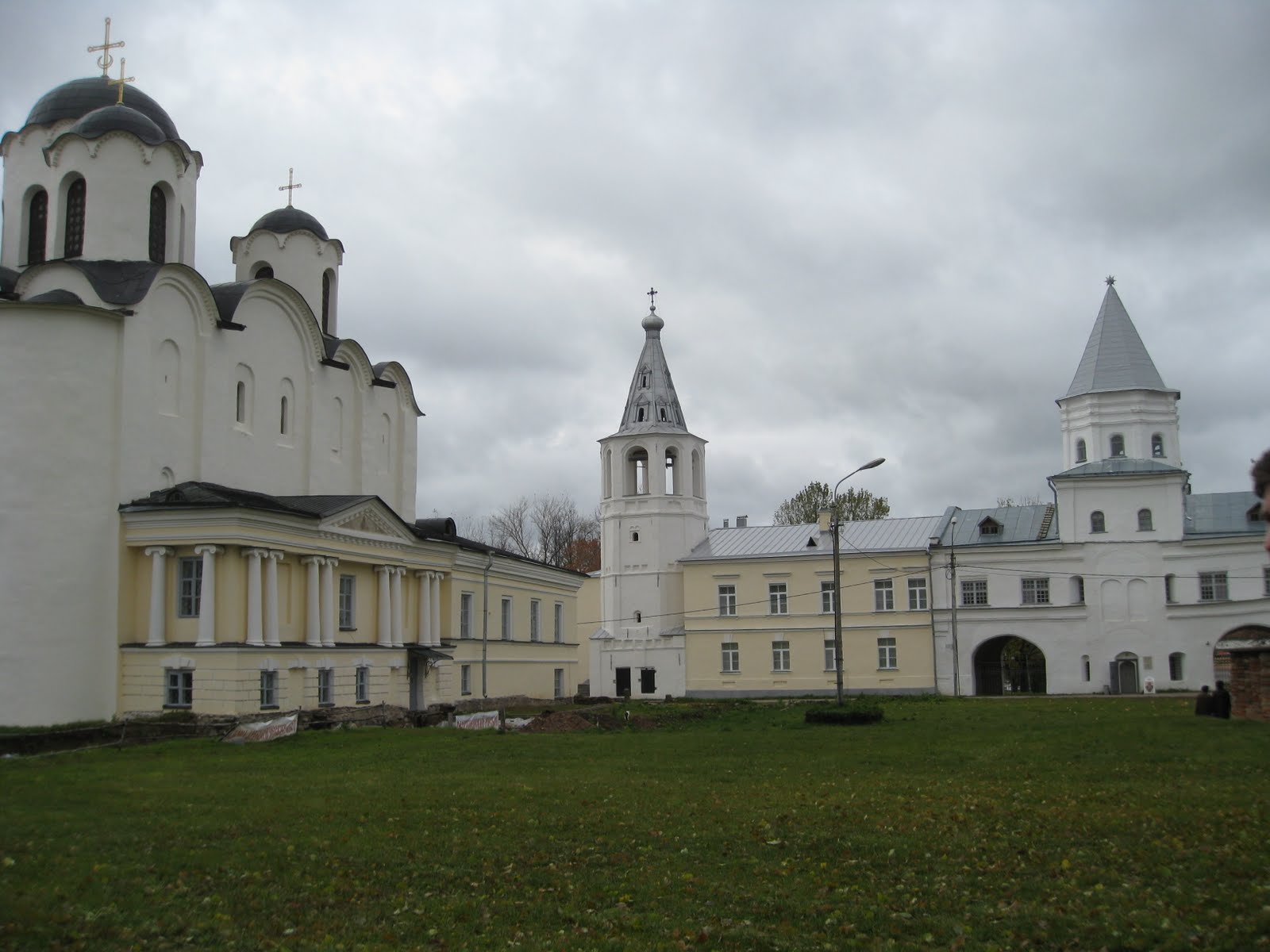

Church of St. Paraskeva Piatnitsa on the Marketplace. 1207.

And a monastery close by.

Спасский собор Юрьева монастыря. 1119.

Tuesday, October 5, 2010

The so-called, and so sought after, immersion.

People are always complaining about how they get so little exposure to their target language in their home countries, pointing out what great progress they would make were they to find themselves in a situation of immersion. Since I have been through immersion once already, or twice if you count Norway, I have no real illusions about how much progress I expect to make. Three months is not a very long time.

I have now been in Russia for almost a month, and what kind of progress have I made? I have no idea. I don't think my spoken Russian is all that much better, however I find it easier to use since I am in contact with it in a more natural way every day. I don't speak all that much Russian though, and the occasions I have spoken most Russian on here have been while meeting my old Russian friends Alexey and Sasha, who neither of them lives here. We have speaking classes, but they are often used for reading, something I find weird, and a lot of the time is used on defining words. Luckily, the class was divided into two groups after 1 1/2 week, so we don't have to explain all that many words anymore, but it is still almost driving me crazy. If we are given as an assignment to read a text, then surely people can look up the words they don't know at home and learn them before the lesson? And then the teacher can just assume that we know them? Or is this pure insanity on my behalf? The actual time we end up speaking during our speaking classes is very limited, and of course the teacher speaks very slowly. And that's it for speaking Russian, the rest of the time we speak Norwegian, even though some classes are in excruciatingly slow Russian. I can't really blame anyone though, I'm the one who is here with a group of students who have studied Russian for one year, but I did expect it to be much, much more difficult. I expected to be constantly busy, but I'm actually more busy when I study in Oslo, since we don't have any reading to do here, except for some grammar in our fabulously dry and boring grammar book. What takes up a lot of time for most people are the translations, but I did them before I even left Oslo, so even though some of them are going to be replaced by other texts (because the first ones were too difficult), I saved myself lots of time. The other thing people seem to find time consuming is writing short essays every week, but since I have been a fan of writing essays for a long time that is something I do in 30 minutes or so...

And now that I don't have all that much to do, I'm going to try to resist that old temptation of over studying everything, and instead try to read and watch Russian television and movies, and of course see more of the city. Getting to and from school reduces my amount of free time, but I try to use it as best I can and read on the way, that is what I can get a place to sit or when we don't walk. Actually being in Russia beats most things, so I don't really care all that much about school.


Tuesday, August 10, 2010

1 Month Until St. Petersburg.

This summer hasn't really been my most productive one. I am slowly getting back into some sort of routine, and that will soon be disrupted again as I leave this country for three months. I am finally going to Russia for a longer period of time, but I'm too much of a worrying type to be able to enjoy the thought of it before I know all the practical details are sorted out (we still don't know exactly where we are going to live, we haven't paid the fees, and so on...) I have read the only course book we have that is not all about grammar, Мы похожи, но мы разные (I'm not entirely sure that's the title of the entire book, it may just be the first chapter), so I do feel like I have done at least something. Fortunately, I found the book extremely easy to read and I finished it very quickly. I have added all the unknown words I could find to Anki, so I should know them all before I even leave.

After having thought about it for quite some time, I did finally start rereading The Secret History by Donna Tartt, and I'm loving it just as much as I did the first time, eight or so years ago. I am a bit puzzled as to how so many language enthusiasts have managed to miss this book. Seriously, it should be a rather natural book to read for anyone who is overly interested in some language. When I read a really good book I always want to read more, and even though I want to read more Russian before I leave, I also have some very interesting books on Russia and I would really have liked to read at least one of them before leaving. Naturally, this doesn't make it any easier to squeeze in any German and Hungarian, especially since I have a final essay to write for my women's history class as well.

And I think Yandex fixed that problem dealing with automatically starting to type in the search field after a search! :D

Wednesday, June 3, 2009

Mini immersion.


My book acquisitions (plus two books I already had), my lovely матрушка and the adorable notebook Aleksey and Lilja (if I'm not mistaken) made.


So I spent two weeks in the splendid country of Russia. I will make a post later on about the things I love about it, but today it's about the language immersion I got.

I have never actually been on a mini immersion before. I was in the US for two weeks twice when I was 7 and 10 and I do believe that greatly helped my English, but it was too long ago to remember much and I was very unconscious about the whole language aspect since English was never a difficulty back then. Then I was in France for ten months in 2004/2005 and for two weeks in 2007, but that second period was of no importance since the long immersion did all the work. I had never visited a Russian speaking country before though, nor truly spoken to "real" Russians.

When I studied French and first went to France, I thought the whole having to accord adjectives to nouns and conjugate verbs thing was a hassle. In Swedish, you just need to know the words in order to use them, there are practically no things that need changing! Well, Russian is somewhat worse, it's quite a feat to try to put together a correct sentence while remembering all the cases. In writing that is not such a big problem for me, I am more of a visual "text person", I see the case endings and the grammar structures, but I do not feel them when I speak. Also, when writing you have more time to accord things, even if you write fast ;) Speaking is… well… difficult. I'm not really at the point where I can use cases comfortably in speech yet; I have to constantly correct myself as I go along and realize that whoops, no, that feminine word should have no ending in plural genitive, or just simply damn, how on earth is this word declined in plural dative?? Sometimes, I just decide to drop trying to use the correct case for a word and just employ the nominative form in order to actually say something and not just stand there thinking about declination tables while the other person confusedly waits…

However, I'm really bad at the whole speaking part of languages. Mainly, I guess, because I never really liked talking at all and I have always talked very, very fast, most likely from fear of being interrupted (something that is a bad thing in Sweden, interrupting is impolite, it doesn't work as in France where you just cut people off all the time). And as I have always been told in school and elsewhere to "SLOW DOWN!" I think I ended up feeling uncomfortable speaking and preferred to just shut up instead. When I speak French and English I also speak very fast, and when I try to speak Russian, I automatically go into a too high gear and make things harder for myself since that gives me less time for conscious grammar coordination. When I've had a couple of beers, my language self-awareness goes down a notch, like for everyone else, and I feel much more comfortable speaking. So, in that way, Russia being like Russia is is a good thing.

So, what can two weeks do? It surely makes the language feel much more familiar and "normal", not like an oddity that you only listen to at home. I'm not sure I got very, very far as far as it comes to speaking abilities, simply because I didn't speak all that much. It rather felt as if I was getting worse as time went by, because some people seemed to think I understood nothing of what they said and then that made me nervous about speaking to them. I spoke with much more ease with certain people (some are so easy to understand, others just emit Russian sounds), and with some others, I more or less felt retarded language wise. It is also quite hard to speak to people who have no conception at all of language learning. They don't understand why you mix up cases and they don't understand when you are trying to find the right case. Such people also tend to complete your sentences once they have understood what you are trying to say, and of course that makes for less speaking practice ;) Those who have ever looked at their language from the viewpoint of someone learning it will react in a whole different way.

Another aspect of Russian that made things trickier in "real life" situations, are all (and there are quite a lot of them) the small words they use that don't really mean that very much. Так, вот, там etc. Once I just stopped listening when one person was talking and started counting "там" or "так":s (I can't remember which one it was), and there were at least 2 per sentence. Some people naturally use more such words than others, and they break up the logic of the phrase, making it harder to understand.

Most people say that you need to wait a bit to get the full effect after an immersion, so I'll wait and see what happens. Russian sure does feel more comfortable than before I left. In my head, it is very clear. I can hold long conversations with myself in my head and I don't screw up a whole lot at all, but as soon as I have to open my mouth, I start to stumble on syllables that seemed absolutely clear and simple. Not because they are necessarily hard to pronounce, but my speech rhythm and everything get completely thrown off when I have to produce the actual words. I always wonder why on earth did that phrase turn out that chopped up and weird, paused and awkward, when it seemed to easy and clear in my head? I think my main pronunciation problem is caused by the soft consonants, that I can often pronounce when isolated, but that I forget aaaaall about when I'm in panic about trying to tell someone about something before they lose interest. I do not mind at all having a different intonation pattern or an accent, but I do mind when I think I should be able to say something in a certain way, and then it turns out just… weird.


Well. Go Russia!