Showing posts with label books. Show all posts

Monday, April 9, 2012

Tallinn.

First - the few photos I took when it wasn't snowing.

I love everything that looks like this.


Tallinn does have that Russian feel, and you do find Russian cafés with all your typical tarts and cakes. You also find these kinds of café's, which to me feel extremely "hip-Scandinavian". Everything is 10 times as expensive in these kinds of cafés. Of course.


English-inspired pub. I love the straightforward wine menu, and the clock to the left. I had at least two raspberry beers and one cherry beer here. Stuff you don't find in Norway! Here we also met some people who took us to local bars, the kind that doesn't close (and that doesn't have any signs signalling they are actually there), until five in the morning।


View over Tallinn.

Every time I go on a holiday, I always end up with feet that hurt. You aren't that very sure about the public transport system, so you end up walking a lot more than you usually do, and you usually do this for several days in a row. You can however visit Tallinn without any excessive strain on your feet, because the city is tiny! Well, I'm sure it isn't actually that small, but when it's constantly snowing or raining, you don't necessarily go that far outside of the city center.

I like Tallinn. In the old city you get that medieval feeling, very similar to the Old Town in Stockholm, just bigger and better, and outside of it, you get that same feeling as in Russia. Perfect. There's even a Russian market, Russian book stores and lots of Russian food! If there's something to say about Tallinn, it's that in this city they can brew coffee and cook absolutely delicious food! I don't think I've ever visited any place where the coffee has been as good (the worst place for coffee EVER is Paris, Oslo is half decent, St. Petersburg is expensive and not very good and Kiev is just fine, just to mention a couple of cities).

Things that you have to visit if you go to Tallinn: the Nevsky Cathedral, the Russian market, Boheem café, Town Hall medieval pub (very good food and beer!) and Kompressor (best pancakes ever).

Funny thing about my trip to Tallinn is that it has rekindled my interest for Hungarian. In a Russian bookstore (or rather, the Russian part of a big Estonian bookstore) I found a series of Ilya Frank reading method books, and not in the typical, boring languages, but in Arabic, Turkish and Hungarian! Even though they were somewhat costly, I had to get the Hungarian one, and I can't wait to start reading it! The method more or less consists in a text, where you first have a sentence in Hungarian, then in Russian within brackets, with some small comments when necessary, and then the same passage again entirely in Hungarian. It helps you read things without the use of a dictionary, and you can just read the all Hungarian text and check if you got it right by then consulting the interlaced text. Quite handy.

I also managed to read some books during my trip, and I thought I'd give them short reviews here.


Embers by Sándor Márai.

This book starts off a bit weak, but then it gains something with every page. It's like a mini mystery, where you know that something has happened, that someone is perhaps dead and that this has had an immense impact on the main character, but you have no idea what actually happened, and the story unfolds mainly through a monologue. This book should be read rather quickly I think, so that you more or less stay in real time with the dialogue/monologue that unfolds the mystery.


Джаз-банд на Карловом мосту by Дина Рубина.

I kind of liked На солнечной стороне улицы, even though it had its faults. This book mostly has faults. There is one brief passage in the beginning, dealing with Kafka and letters written to and from Kafka (i.e. not written by the author) which are interesting. Anything she has written herself is just crap. This book is supposed to be a recollection of journeys to different countries, something about the atmosphere or soul of each place. I think that was supposed to be the point. Instead, it's the arrogant bragging of a mediocre Russian author (who has published 40 books! Who is invited to hold lectures! Who understands people in any language without actually knowing the language, just through her superior ability to communicate! Who loves to bring up the martyrdom of the Jews every chance she gets and who has absolutely no idea how to use punctuation!). I hate this book so much that I actually didn't read the last 15 pages and left it on the bed in the hostel in Tallinn.


Monsieur Vénus by Rachilde.

This could have been quite good. I had never heard of Rachilde before, and I kind of suspected that was because she wasn't actually a good writer. Kind of like Marquis de Sade; she can't write, but she writes about scandalous things, so she gets famous anyway. This book (from 1884) about a woman, who is perhaps more like a man, who meets a man, who is perhaps more like a woman, does have some interesting things in it, and it wasn't boring to read, but sometimes it just embarrassingly melodramatic and weird.

Sunday, March 25, 2012

Just what I needed!

I love it when you go to a flea market, find 11 books in like 10 minutes and your friend does not go "should you really buy that many books?" but instead says "should I help you carry that?", and the guy selling them agrees to give them all to you for some eight euros. Heaven.

As we left, I saw a huge room with more boxes of books through the window. Walking away was hard, but necessary.

And I forgot to look for the things I went there for.

Anyway!

And I have no idea why Blogger turns the picture around. It has never done it before. Any ideas?


Donna Tartt - The Secret History. I have read and loved it twice, but never owned it. Now I have a tattered Norwegian copy.

Karen Armstrong - A History of God: The 4,000-Year Quest of Judaism, Christianity, and Islam. Looked really interesting.

Anne B. Ragde - Berlinerpoplene & Eremittkrepsene. Very famous Norwegian books that I haven't read.

Emmanuel Carrère - D'autres vies que la mienne. I've read Carrère before, before being fluent in French. I thought I should try another one now that I will understand 100%.

Morris Bishop - The Penguin Book of the Middle Ages. This just looked interesting.

Sándor Márai - Embers. I've been wanting to read something Hungarian for a long time.

Herta Müller - The Land of Green Plums and Even Back Then, the Fox Was the Hunter. Ever since she won the Nobel Prize and I heard of her I've been interested in reading some of her books.

Kazuo Ishiguro - Never Let Me Go. A friend of mine read this book recently and really liked it, and I haven't read anything by Ishiguro at all.

Monique Truong - The Book of Salt. I get the impression I see this book everywhere and I took that as a sign.

Sunday, May 8, 2011

More cat.

Norwegian has one word that is very cute: ymse. In Swedish, I would use a far less exciting word, notably diverse. This word suits this post very well, because it's just a little bit of everything.

I have almost caught up with my book reading. With almost I mean that I've been cheating a bit. In order to be able to say that I have read anything at all, I decided to throw in the tiny volume Mordre au travers by Virginie Despentes, and since I finished reading Three Sisters in Russian, I will count that as well.

So what do I have to say about Mordre au travers? This is a collection of short stories written in the 90s; most of them in classical prose, two in a semi-poetry format. First of all, I must say that Despentes is not the kind of author that is suited for collections of short stories. Her short stories are always sensational, and they are best enjoyed one by one in some obscure literary journal. When you read them in a collection like this, you get used to the format and you know that whatever the topic is, it's going to end very, very badly. And it does. This collection of short stories contains the most provocative material I have seen from Despentes so far. Sometimes, it's too provocative and it loses parts of its literary value because of it. But some of these short stories contain very good stuff. Despentes is very skilled at creating frantic inner monologues. And she can paint a picture that will stay put in your mind for quite some time. These short stories talk about sex, prostitution, poverty, murder, weird stuff and self-hatred. Sale grosse truie is among the saddest things I've ever read. A terme is definitely one of the most disturbing things I've ever read - but it may be going go a bit over the top (people with children should probably not read it). A little bit less sensational, and it would have been better. I very much like the touch of... fantastique, that she quite unexpectedly threw into two of the stories. I see myself rereading these stories sometime in the future, and that's a really good sign. As I was reading them, I did however feel that something was missing in them, that they could have been better than this. Or other, that they should have been.

And today I happened to visit a flea market.


A friend of mine didn't know who August Strindberg was during our bi-monthly Quiz at University, so for her birthday - as a joke - I gave her one of his books in Norwegian. Since I have been wanting to re-read Röda Rummet (the only novel of his that I have read), I was quite pleased to find it today in Swedish (together with three other works by him). I'm not reading Swedish classical literature in Norwegian. Anyway, I find it quite strange that Norwegians should not know who Strindberg is, when they are so obsessed with Sweden. Now, I'm not sure if regular Swedes know who Hamsun and Ibsen are, but I "always" have. As a funny side note, when the Russian author Aleksej Slapovskij visited Oslo during the Russian days at the House of Literature, he spoke of how Russians are interested in the culture of other countries. He said that they are familiar with Norwegian authors, and listed Hamsun and Strindberg ;) The audience began laughing (it happened to be an educated one, with people who know who Strindberg is and where he comes from) and then he corrected himself with "of course I meant Ibsen". Alexander Kielland is a classic Norwegian realist author, and I have already mentioned Bjørneboe a thousand times. I haven't actually read anything by Rainer Maria Rilke, but I've understood that I should, and I have Lettres à un jeune poète in French.

I got a request for more photos books, and since a cat happened to climb into this particular bookshelf, I couldn't resist taking a photo of it. A second cat came to join it.


Even though I should be preparing for exams and writing essays, I have been flirting with... Lithuanian. It's a very cute looking language, and it is a very interesting one because of its archaic character. I haven't been doing anything serious with it though, I've just done a couple of lessons over at http://ikindalikelanguages.com - a great site for easy going introductions to languages. The site happens to be owned by a Lithuanian, so the Lithuanian course is quite extensive, and very much fun!

Wednesday, April 20, 2011

Some new pearls for my collection.

This year for my birthday I got some books! This may be a bit difficult to believe, but I don't get books all that often, I mostly just buy them myself.


And no, the books on linguistics (Linguistics - An Introduction to Language and Communication and Women, Men and Language) are not course literature. They will constitute my self-study this summer when I'm not taking any summer classes. Thom in Paris was kind enough to send me the Despentes books (Baise-Moi and a collection of short stories entitled Mordre au travers) that I simply can't wait to start reading! They are perfect additions to my small Despentes collection. The book on top, Art Poétique, is a book I always imagined as extremely dry and boring whenever it was mentioned in literature class in France. As I was writing an essay on Anna Akhmatova for my Russian literature class, I started thinking about Boileau and decided to check out his Art Poétique (instead of just reading about it) on GoogleBooks, and realized it was highly amusing and actually fun to read! So, thank you eBay for this tiny little book!


And how delightful is not this absolutely beautiful Russian tea cup? I can safely say it's the most awesome teacup I have. Thank you Sasha!

Since it's my birthday today I thought I should do something that I sincerely want to do, and the one thing I could think of was to read the Fountainhead. Yesterday I picked out my "Book Book", a relic from when I was younger and much more diligent. Doing a year or two or three or four I used to write two pages on every book I read in a book entitled "Bokboken" (The Book Book, and I even created a website based on it, "The Library"), and I was quite surprised when I realized yesterday how much I actually wrote in this book. The sad thing is that I can't find the first such book I filled. I'm really hoping it's hidden somewhere and not lost forever. This second book contains 164 reviews, on 328 pages... numerated, and with an additional index so that I can easily find the book I'm looking for. The reviews date from the 28th of January 2004 to the 10th of August in 2006, with very little posts from my time in France (autumn 2004-summer 2005). Before and after that the average time span between reviews is two days. And now I'm struggling to read one book a week.

The reason I wanted to find this book again was to find out what I wrote about the Fountainhead back then. I was quite conscious of the fact that my opinion of books changed over time, so I wanted to preserve my instant impressions so as not to be fooled into believing I liked or disliked a certain book later on. Reading these "reviews", I realize how severe a critic I was back then. And how absolutely right I was about how opinions change over time. Upon completing the Fountainhead (on March 25th 2004), I wrote "Overall, I like this book, but not that very passionately, not as much as I could have liked it. [...] There is probably quite a lot to complain about concerning the literary quality and the characters. For example, Roark and Dominique seem far too similar. Both of them annoyed me in the beginning because of their indifference (which reminds me of some of today's youth), but as for Roark, this passed rather quickly. [...] But the feeling of disappointment is still there." Hah!

Well, I re-read The Secret History not that very long ago, and thought that I loved it just as much as the first time, but when I finished reading that one on the 23rd of May in 2004, I wrote "I'm in love. But just a bit. I love everything about this book, but still there is something that stops me from calling it a new favorite." Yet I call it an old favorite now.

I am going to try to pick up this habit of writing about books again.

Other than that, I have a iPad 2 at my disposal during the holidays, so naturally I'm spending far too much time playing Bejeweled ^^

Sunday, October 3, 2010

St Petersburg Book Market.


Today we visited the book market in St Petersburg, located nearby the Elizarovskaja metro station. I found the line of tables *outside* the actual market, which is an indoor three floor arrangement, the most interesting part. I am really much more interested in actually OLD books, not just new ones, or modern editions, which are easy to find and not the slightest bit unique. And since I'm looking for classics most of the time, book markets with old dusty books are much better suited for me. Unfortunately, only the outside of the market was like that. Lots of books for 10-20-30-40 roubles! I bought a stack of books for 130 roubles in total within a couple of minutes, and a St Petersburg comic for 50 roubles inside the building (mostly just because the seller was so charming and bubbly enthusiastic about her books). I was a bit annoyed at finding Татьяна Толстая's Крысь for 50 roubles there, because I bought it for 140 yesterday...

Накануне - Тургенев
Записки охотника, Рудин - Тургенев


That is, for those who don't speak Russian, On the Eve and A Sportsman's Sketches by Ivan Turgenev. Ever since reading Fathers and Sons, Turgenev has been one of my favorite Russian authors. I got the impression that he writes in very understandable prose, and I have read one short story from A Sportsman's Sketches before, years ago, and I still remember it, which is surely a good sign. So I am very much looking forward to reading his books, and I'm absolutely thrilled that I found them for just a couple of rubles.

"Сквозь жар души, сквозь хлад ума..." - Некрасов


Not even sure what this is, but I knew that I was supposed to know Nekrasov from somewhere, and the book was just extremely cute.

Стихитворения, поэмы - Лермонтов

Lermontov was one of the first Russian authors I read in Russian, albeit in a bilingual French-Russian edition that I bought in France once; A Hero of Our Time. I really liked it, and since I have been trying to read more poetry for the last five or so years (unsuccessfully) I decided to give his poems a go.

По дорогам Венгрии - Дружинин

I don't really know what this is either, I'm not too sure if it's fiction or not (I think it's fiction, or autobiographical, but I haven't really looked into it very much), but it's about Hungary, it didn't cost a thing, and true to my habit I gave in to the temptation :-)

Мелкий Бес - Федор Сологуб

A long long time ago I read a very strange short story by Sologub, and I am a bit curious about him.

Река жизни - Куприн

Just before leaving Norway I read a short story by Kuprin, after having received recommendations on lang-8, and since I liked that short story, and since I always want to discover new authors, this collection of short stories came in very handy.

Полный пока

This is a highly modern booklet with comic strips from St. Petersburg. They seem to be all black humor strips, and language wise I thought it could be a nice challenge.

These are of course not the only books I have bought so far. The book I'm currently reading is actually not a Russian one, but the author is originally Russian and the book is about St. Petersburg and the Revolution: We the Living by Ayn Rand. I will wait with my judgment on the book until I have read all of it. I also bought a Russian translation of a Francoise Sagan book; Un orage immobile. The edition was just so cute I couldn't help myself. The same goes for Любовь Фрау Клейст by Ирина Муравьёва. I have no idea who this author is, but the book was extremely cheap and it appealed to me somehow. The list goes on with The Idiot by Dostoyevsky and finally a tiny hardcover bilingual poetry collection of poems by Rainer Maria Rilke (German/Russian).

As far as the rest of my stay here is concerned, I haven't actually been in the mood for writing about any of it. I think what I would say would be inadequate anyway. Of course everyone knows that St. Petersburg is an excellent city. I even put up with overcrowded public transport here, and that is saying a lot... ;)

Tuesday, June 8, 2010

Ça a l'air très bien.

Même si je lis déjà trois ou quatre livres, j'ai commencé un nouveau aujourd'hui. Il me fallait quelque chose des léger, littéralement quelque chose qui ne pesait pas très lourd parce que je voulais le lire dans la baignoire. Donc j'ai choisi un petit livre de poche que j'ai acheté en France il y a cinq ans, La Vie Devant Soi de Romain Gary (un russe qui est venu en France à l'âge de 14 ans en 1914). J'en suis déjà très enchantée ! C'est un livre marrant, et déjà sur les premières pages, j'ai trouvé tout cela :

(Le livre commence avec l'histoire d'un enfant de six ou sept ans, et la langue reflète cela. Il vit chez Madame Rosa avec six autres enfants, pour la plupart des enfants de prostituées.)

Je devais avoir trois ans quand j'ai vu Madame Rosa pour la première fois. Avant, on n'a pas de mémoire et on vit dans l'ignorance. J'ai cessé d'ignorer à l'âge de trois ou quatre ans et parfois ça me manque.

...

Monsieur Hamil a de beaux yeux qui font du bien autour de lui. Il était déjà très vieux quand je l'ai connu et depuis il n'a fait que vieillir.

...

Pendant longtemps, je n'ai pas su que j'étais arabe parce que personne ne m'insultait. On me l'а seulement appris à l'école.

...

— Tu sais ce que c'est, une putain ?
— C'est des personnes qui se défendent avec leur cul.
— Je me demande où tu as appris des horreurs pareilles, mais il y a beaucoup de vérité dans ce que tu dis.
— Vous aussi, vous vous êtes défendue avec votre cul. Madame Rosa, quand vous étiez jeune et belle ?
Elle a souri, ça lui faisait plaisir d'entendre qu'elle avait été jeune et belle.

...

Il y avait sur le trottoir d'en face un môme qui avait un ballon et qui m'avait dit que sa mère venait toujours quand il avait mal au ventre. J'ai eu n al au ventre mais ça n'a rien donné et ensuite j'ai eu des convulsions, pour rien aussi. J'ai même chié partout dans l'appartement pour plus de remarque. Rien. Ma mère n'est pas venue et Madame Rosa m'a traité de cul d'Arabe pour la première fois, car elle n'était pas française. Je lui hurlais que je voulais voir ma mère et pendant des semaines j'ai continué à chier partout pour me venger. Madame Rosa a fini par me dire que si je continuais c'était l'Assistance publique et là j'ai eu peur, parce que l'Assistance publique c'est la première chose qu'on apprend aux enfants. J'ai continué à chier pour le principe mais ce n'était pas une vie. On était alors sept enfants de putes en pension chez Madame Rosa et ils se sont tous mis à chier à qui mieux mieux car il n'y a rien de plus conformiste que les mômes et il y avait tant de caca partout que je passais inaperçu là-dedans.

...

Sinon, je suis en train de lire un livre norvégien, un genre de de livre-culte qui a rencontré des problèmes quand il (en fait c'est une trilogie, mais bon...) est sorti dans les années 60. La trilogie s'appelle « L'Histoire De La Bestialité » (auteur: Jens Bjørneboe) et jusque-là, ça parle de la nature des « petits ours », c'est-à-dire des humains, et c'est pas beau ! Par contre, c'est plutôt génial ;)

Thursday, June 3, 2010

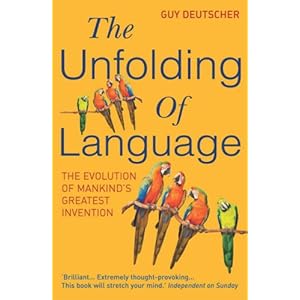
The Unfolding of Language.


I finished reading this book yesterday, and I'm always happy to add another language related book to my list of finished books. Most of them end up in a pile, waiting patiently while I read what's on the curriculum for whatever class I'm taking :-) When people recommend books to me, I tend to read them somewhat quicker though.

I very much enjoyed this book, but I have a couple of complaints to make.

The book mainly deals with different structures in languages and tries to explain how they could have come about. For example, where does the Arabic verb stem system come from? Why are small, isolated languages so incredibly complex? Why do all languages seem to have been more perfect in the past? And so on. Very interesting questions, and the book is very nicely written, with amusing examples. However, at the end there are a couple of appendixes that just seems to be stuff that wouldn't fit in the normal chapters, and I think it makes the book feel a bit unstructured. I also didn't feel like it really had an end. It just ended, but it could probably have gone forever, since he could have continued explaining similar things for hundreds of pages.

What is worse though, is that all of a sudden in the book there is a very long discussion between a linguist (I think) and a moron. The linguist tries to explain how words can shift from one category to another (like from noun to preposition) and the moron refuses to understand. I just couldn't wait until that discussion was over, only to discover it was taken up again in one of the appendixes. It really annoyed me, and it kind of made my impression of the book a bit more negative than necessary.

However, I do recommend it to anyone interested in languages! It's written for people without any extensive linguistic expertise, so it's also the kind of book you can bring to the beach. If you go to the beach. I personally prefer my balcony.

Monday, April 19, 2010

Such beauties.

The balance in the universe was today re-established as I bought three books. It's been quite a while since I last bought books, and shamefully enough I only bought one in France. But then I have also been too absent-minded lately to read, so I feel a bit stupid about buying books. Anyway, they are probably very good ones.


The quarrelsome seal that was eyeing a disenchanted but rather attractive fish that was jumping in and out of the icy water has picked a fight with a phlegmatic walrus that was innocently passing by.

Yes, I have already started reading "The Unfolding of Language", since it was recommended to me, and it has made me chuckle quite a couple of times, so I'm well pleased. I was actually just going into the book store in order to pass some time and to have a look at this book that I was thinking about buying, and then I saw that there was a "three for the price of two" sticker on it, and I had a look around to see if there was any other books that seemed highly interesting. When my eyes fell on Orlando Figes' book I just started looking for a third one in order to justify buying them. I have been reading, and very much enjoying, Figes' "A Cultural History of Russia" (I haven't actually finished it yet but it's never boring) so I am looking forward to reading his book about private life in Stalin's Russia.

Finally, the third book had "for people interested in language, this is a must" written on the back of it, and I recognized the title. Not a very difficult decision.

The book that I did actually buy in Paris (and I'm going to make a photo post about the trip as soon as I get the photos) was this one, and I guess you can see that there is a certain trend in the books I buy...


Tuesday, February 23, 2010

Very much yes.


Today I finally got the books I ordered some time ago. Isn't this beautiful? I'm especially impressed by the fact that the Russian book only cost like eight euros. Just for the fun of it, I'm not going to wait until I reach some sort of level in German until I start reading :-)

Monday, July 13, 2009

Nonfiction books.

Not everyone likes to read fiction, something which can be very unfortunate of course, but that's just the way it is. It seems that a lot of the people who do not like great literature can on the other hand enjoy some science fiction or fantasy, so even if they cannot be made to read Dostoyevsky, they may accept Douglas Adams (and why not in a Russian English edition with pictures?) or Terry Pratchett, just to take some examples. However, if you are into a bigger language, such as Russian, you can use reading extensively in your studies without ever touching any filthy fiction, and without having to go to Russia in order to find books (even though that is much nicer than reading something off a screen).

AvaxHome is here to save us, or them, since I for one do not mind fiction. At this extraordinary, albeit ugly and slightly impractical, site, you can find books about everything. For Russian, that is actually true: cooking, airplanes, programming, maths, physics, chess, makeup, history, literature, languages, aviation, health... this could continue forever. I haven't browsed the site for other languages that very much, but I suppose that their categories aren't that bad either.

These are the books I found today while going through the feeds in my RSS reader:

Неизвестный СССР. Противостояние народа и власти 1953-1985 (The unknown USSR. The opposition of the people and the authorities 1953-1985)
Сказания о начале славянской письменности (The story of the beginning of the Slavic written language.)
Русские обряды и традиции - Народная кукла (Russian ceremonies and traditions -the folk doll)
Быт и нравы Древней Руси (Way of life and customs of the ancient Rus')
Русские руны (Russian runes)

All this is excellent, now I just have to find some time in order to read them.

Sunday, June 21, 2009

For those learning Russian.

In July there will be a Russian Book Club at the HTLAL Forums. We are going to read short stories by Teffi. You can read more about it here and sign up on the Forum if you are not already a member ;) You needn't be very advanced to participate!

Monday, May 4, 2009

[FR] Lecture recommandée

Un auteur que j'aime bien, mais dont on parle rarement me semble-t-il, c'est Jean Giono. En 2004/2005, son « Un roi sans divertissement » était sur le programme de littérature des Littéraires Terminales et je pense encore aujourd'hui à ce livre avec un petit « iih », ce qui est bon signe.
Giono, c'est un auteur qui vient de la Provence il écrit souvent à propos de la nature et de la Provence, mais « Un roi sans divertissement » se déroule par contre dans les montagnes, non très loin de Grenoble, en pleine neige. Pour moi, qui aime la montagne et la neige, c'est un très bon fond de toile.

L'histoire (en très court, car je n'aime pas quand on dit trop sur un livre) : chaque hiver, dans un petit village, des hommes commencent à disparaître dès que la première neige tombe. La seule trace qui reste, ce sont quelques gouttes de sang.

Le titre de cette oeuvre est bien sur intéressant. Afin de comprendre l'oeuvre, il faut nécessairement savoir d'où vient l'expression, « un roi sans divertissement » et ce que cela veut dire. C'est bien sur Blaise Pascal (1623-1662) qui est la source de la fameuse citation « Un roi sans divertissement est un homme plein de misères » qui se trouve dans son « Les Pensées », et la signification est peut-être assez évidente ?
Je conseillerais d'ailleurs quiconque de feuilleter un peu « Les Pensées » de Pascal, il y a beaucoup de sagesse dans ce qu’il dit. Parfois.


Un extrait du livre peut-etre ?

Je n'ai, comme bien vous pensez, jamais goûté le sang de personne; et aussi bien je dois vous dire que cette histoire n'est pas l'histoire d'un homme qui buvait, suçait, ou mangeait le sang (je n'aurais pas pris la peine, à notre époque, de vous parler d'un fait aussi banal), je ne veux pas parler du goût (qui doit être simplement salé), je veux dire qu'il est facile d'imaginer, compte tenu des cheveux très noirs, de la peau très blanche, du poivre de Marie Chazottes, d'imaginer que son sang était très beau. Je dis beau. Parlons en peintre.