Going home for Christmas for me usually means having lots of time off. No laundry to do, no cleaning up to do, no dishes... I have wasted a couple hours on a rather hilarious, albeit depressing, misogynic blog (unfortunately Swedish, which makes me a bit ashamed of being Swedish) debating with the kind of mindnumbing people you only find on the Internet, that which only made me realize even more what I actually want to spend my time doing: reading. I finished reading The Diary of a Chambermaid, but I can't finish Justine, because it's left at home in Oslo. Funnily enough, considering what I've been debating the last day or two, I started a book that actually deals somewhat with feminism (without knowing it beforehand). I got one book for Christmas, and it couldn't have been more perfect - Utrensning by Sofi Oksanen (in a delicious edition). But since I'm taking that one home with me anyway, I decided to read a book from my mother's collection, and since The World According to Garp is one of those books I have always seen everywhere, I decided to give it a go. I'm reading it in Swedish.
So what can I say about The Diary of a Chambermaid? I LOVE the love-eroticism-crime connection, and I think that's what I will remember about this book. I'm very curious to see how that plays out in the movie. It was surprisingly easy to read, at the same time as I learned many new, quirky words. I bought this book years ago so I'm very happy I finally actually read it! The only thing that I kind of have against this book is the fact that the main character isn't always very sympathetic. The main characters don't always have to be, and the fact that I did actually end up liking her, despite her faults (such as occasional stupidity and inability to plan ahead), perhaps only speaks in favor of the author. I'm not actually sure whether she was supposed to be likable or not... can someone else read the book and tell me what they think?
The World According to Garp is very amusing, but way longer than I thought. I had my doubts about actually being able to finish it before going home, but then I read 40% of it today, so I guess that won't be a problem. I can already recommend it.
Saturday, December 25, 2010

Friday, December 24, 2010
Illustrations.
In an attempt to very shortly illustrate my stay in Russia (not Russia in general), I have chosen a couple of photos. Adding as I find them!

Need I explain?

The law abiding citizens of Russia.

Churches. In cold places. Toes leaving this world in protest and me wondering why my winter shoes aren't more wintery.

Endless glasses of beer. Baltika, Nevskoe, my dear Dr. Diesel...
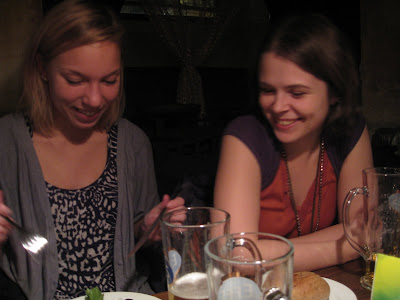
Food AND beer, and cheerful people.

Christmas decorations in unnatural, non-Christmas:y colours!

Nevskij prospekt, the eternal Nevskij prospect!
 Drunken friends! Utterly Scandinavian, 4 Norwegians, one Dane and a Swede!

I ended the Paris photo post with me and Sasha. Quite appropriately, this photo post should end with my partner in crime in Russia, Maja, and me! Russian style :D

Need I explain?

The law abiding citizens of Russia.

Churches. In cold places. Toes leaving this world in protest and me wondering why my winter shoes aren't more wintery.

Endless glasses of beer. Baltika, Nevskoe, my dear Dr. Diesel...

Food AND beer, and cheerful people.

Christmas decorations in unnatural, non-Christmas:y colours!

Nevskij prospekt, the eternal Nevskij prospect!
 Drunken friends! Utterly Scandinavian, 4 Norwegians, one Dane and a Swede!
I ended the Paris photo post with me and Sasha. Quite appropriately, this photo post should end with my partner in crime in Russia, Maja, and me! Russian style :D
Coincidence?
I made it back from Russia. With what? Well, better knowledge of Russian grammar (способ действия, in particular - very handy for reading literature! But for the life of me I can't incorporate any of them in my speech...), perhaps some improvement in my spoken Russian - which to my great surprise was deemed better than my ability to translate! I always thought it was the other way around. I'm happily back though, after all, although I currently find myself in the north of Sweden where it's OMFG cold and I'm doing... nothing but reading.
While in Russia, I got inspired to read more, and as a consequence, languages are on hold for the moment. I'm reading instead. I will write a post on my "guilty pleasure" reading later, but this post is about two books that have quite some things in common, even though I hadn't really realized it until last night.
Let's make a list! Both books...
* take place in 18/19th century France (exact years escape me)
* are written by Frenchmen (one in 1787, the other was finalized in 1900)
* deal with the lives of young women
* deal with the lives of young women who constantly get into trouble
* are highly subversive
* reveal the hypocrisy and debauchery of the "fine world"
Perhaps I should have picked up on those similarities a little bit earlier?
I'm reading one of them in Russian, because I found it in a 2nd hand book store in St-Petersburg, the other I found at the top of one of my book boxes that haven't been unpacked yet in our new apartment.
1. Justine by Marquis de Sade
2. Le Journal d'une Femme de Chambre by Octave Mirbeau (The Diary of a Chambermaid)
Octave Mirbeau's book is of course of a somewhat higher literary quality, even though the style is made out to be that of an actual chambermaid. Marquis de Sade has never really struck me with his awesome prose, not even in Russian (reading in foreign languages tend to make miserably poor prose seem better since you're too bad at the language to realize what crap you are reading)... I'm not saying Sade is THAT bad, he's just no... Emily Brontë. Reading Sade is always a case of curiosity, for the fun of it, not because he's a great author or because his philosophic ideas are breaht taking. Moral relativism is after all as comfortable and easy as it gets within moral philosophy!
The misfortunes of Mirbeau's chambermaid are of the "naww, poor girl" kind, plus dear Célestine doesn't complain all that much and is not trying to dissimulate her true nature from the reader. Justine, on the other hand, runs into the kind of stuff that goes two thousand miles beyond "naww..." and is, herself, a Saint (at least so far). So, yes, Mirbeau's books is a *bit* more nuanced and interesting. Sade's book makes you finally understand why sadism was given his name - some of his other books certainly don't, nor does his life - but I hardly doubt you will finish it with a sense of "oh I can so totally recognize myself in the characters" or "oh my god, this book has changed my life". Mirbeau has some points, and I find myself wishing I had a book to write down quotes in.
Okay, just one! Just one!
L'habitude agit comme une atténuation, comme une brume, sur les objets et sur les êtres. Elle finit, peu à peu, par effacer les traits d'un visage, par estomper les déformations; elle fait qu'un bossu avec qui l'on vit quotidiennement n'est plus, au bout d'un certain temps, bossu...
So I have this tendency to write about books I have yet to finish... I will write again once I have read them до конца, and see what I think about them then. Mirbeau's book is full of anti-Semitic stuff (one of the characters is an anti-Semite) and was written during the Dreyfus affaire, so I have to look into that more, and there's a movie with Jeanne Moreau. Fun fun!
While in Russia, I got inspired to read more, and as a consequence, languages are on hold for the moment. I'm reading instead. I will write a post on my "guilty pleasure" reading later, but this post is about two books that have quite some things in common, even though I hadn't really realized it until last night.
Let's make a list! Both books...
* take place in 18/19th century France (exact years escape me)
* are written by Frenchmen (one in 1787, the other was finalized in 1900)
* deal with the lives of young women
* deal with the lives of young women who constantly get into trouble
* are highly subversive
* reveal the hypocrisy and debauchery of the "fine world"
Perhaps I should have picked up on those similarities a little bit earlier?
I'm reading one of them in Russian, because I found it in a 2nd hand book store in St-Petersburg, the other I found at the top of one of my book boxes that haven't been unpacked yet in our new apartment.
1. Justine by Marquis de Sade
2. Le Journal d'une Femme de Chambre by Octave Mirbeau (The Diary of a Chambermaid)
Octave Mirbeau's book is of course of a somewhat higher literary quality, even though the style is made out to be that of an actual chambermaid. Marquis de Sade has never really struck me with his awesome prose, not even in Russian (reading in foreign languages tend to make miserably poor prose seem better since you're too bad at the language to realize what crap you are reading)... I'm not saying Sade is THAT bad, he's just no... Emily Brontë. Reading Sade is always a case of curiosity, for the fun of it, not because he's a great author or because his philosophic ideas are breaht taking. Moral relativism is after all as comfortable and easy as it gets within moral philosophy!
The misfortunes of Mirbeau's chambermaid are of the "naww, poor girl" kind, plus dear Célestine doesn't complain all that much and is not trying to dissimulate her true nature from the reader. Justine, on the other hand, runs into the kind of stuff that goes two thousand miles beyond "naww..." and is, herself, a Saint (at least so far). So, yes, Mirbeau's books is a *bit* more nuanced and interesting. Sade's book makes you finally understand why sadism was given his name - some of his other books certainly don't, nor does his life - but I hardly doubt you will finish it with a sense of "oh I can so totally recognize myself in the characters" or "oh my god, this book has changed my life". Mirbeau has some points, and I find myself wishing I had a book to write down quotes in.
Okay, just one! Just one!
L'habitude agit comme une atténuation, comme une brume, sur les objets et sur les êtres. Elle finit, peu à peu, par effacer les traits d'un visage, par estomper les déformations; elle fait qu'un bossu avec qui l'on vit quotidiennement n'est plus, au bout d'un certain temps, bossu...
So I have this tendency to write about books I have yet to finish... I will write again once I have read them до конца, and see what I think about them then. Mirbeau's book is full of anti-Semitic stuff (one of the characters is an anti-Semite) and was written during the Dreyfus affaire, so I have to look into that more, and there's a movie with Jeanne Moreau. Fun fun!
Tuesday, October 5, 2010
The so-called, and so sought after, immersion.
People are always complaining about how they get so little exposure to their target language in their home countries, pointing out what great progress they would make were they to find themselves in a situation of immersion. Since I have been through immersion once already, or twice if you count Norway, I have no real illusions about how much progress I expect to make. Three months is not a very long time.
I have now been in Russia for almost a month, and what kind of progress have I made? I have no idea. I don't think my spoken Russian is all that much better, however I find it easier to use since I am in contact with it in a more natural way every day. I don't speak all that much Russian though, and the occasions I have spoken most Russian on here have been while meeting my old Russian friends Alexey and Sasha, who neither of them lives here. We have speaking classes, but they are often used for reading, something I find weird, and a lot of the time is used on defining words. Luckily, the class was divided into two groups after 1 1/2 week, so we don't have to explain all that many words anymore, but it is still almost driving me crazy. If we are given as an assignment to read a text, then surely people can look up the words they don't know at home and learn them before the lesson? And then the teacher can just assume that we know them? Or is this pure insanity on my behalf? The actual time we end up speaking during our speaking classes is very limited, and of course the teacher speaks very slowly. And that's it for speaking Russian, the rest of the time we speak Norwegian, even though some classes are in excruciatingly slow Russian. I can't really blame anyone though, I'm the one who is here with a group of students who have studied Russian for one year, but I did expect it to be much, much more difficult. I expected to be constantly busy, but I'm actually more busy when I study in Oslo, since we don't have any reading to do here, except for some grammar in our fabulously dry and boring grammar book. What takes up a lot of time for most people are the translations, but I did them before I even left Oslo, so even though some of them are going to be replaced by other texts (because the first ones were too difficult), I saved myself lots of time. The other thing people seem to find time consuming is writing short essays every week, but since I have been a fan of writing essays for a long time that is something I do in 30 minutes or so...
And now that I don't have all that much to do, I'm going to try to resist that old temptation of over studying everything, and instead try to read and watch Russian television and movies, and of course see more of the city. Getting to and from school reduces my amount of free time, but I try to use it as best I can and read on the way, that is what I can get a place to sit or when we don't walk. Actually being in Russia beats most things, so I don't really care all that much about school.


I have now been in Russia for almost a month, and what kind of progress have I made? I have no idea. I don't think my spoken Russian is all that much better, however I find it easier to use since I am in contact with it in a more natural way every day. I don't speak all that much Russian though, and the occasions I have spoken most Russian on here have been while meeting my old Russian friends Alexey and Sasha, who neither of them lives here. We have speaking classes, but they are often used for reading, something I find weird, and a lot of the time is used on defining words. Luckily, the class was divided into two groups after 1 1/2 week, so we don't have to explain all that many words anymore, but it is still almost driving me crazy. If we are given as an assignment to read a text, then surely people can look up the words they don't know at home and learn them before the lesson? And then the teacher can just assume that we know them? Or is this pure insanity on my behalf? The actual time we end up speaking during our speaking classes is very limited, and of course the teacher speaks very slowly. And that's it for speaking Russian, the rest of the time we speak Norwegian, even though some classes are in excruciatingly slow Russian. I can't really blame anyone though, I'm the one who is here with a group of students who have studied Russian for one year, but I did expect it to be much, much more difficult. I expected to be constantly busy, but I'm actually more busy when I study in Oslo, since we don't have any reading to do here, except for some grammar in our fabulously dry and boring grammar book. What takes up a lot of time for most people are the translations, but I did them before I even left Oslo, so even though some of them are going to be replaced by other texts (because the first ones were too difficult), I saved myself lots of time. The other thing people seem to find time consuming is writing short essays every week, but since I have been a fan of writing essays for a long time that is something I do in 30 minutes or so...
And now that I don't have all that much to do, I'm going to try to resist that old temptation of over studying everything, and instead try to read and watch Russian television and movies, and of course see more of the city. Getting to and from school reduces my amount of free time, but I try to use it as best I can and read on the way, that is what I can get a place to sit or when we don't walk. Actually being in Russia beats most things, so I don't really care all that much about school.


Sunday, October 3, 2010
St Petersburg Book Market.

Today we visited the book market in St Petersburg, located nearby the Elizarovskaja metro station. I found the line of tables *outside* the actual market, which is an indoor three floor arrangement, the most interesting part. I am really much more interested in actually OLD books, not just new ones, or modern editions, which are easy to find and not the slightest bit unique. And since I'm looking for classics most of the time, book markets with old dusty books are much better suited for me. Unfortunately, only the outside of the market was like that. Lots of books for 10-20-30-40 roubles! I bought a stack of books for 130 roubles in total within a couple of minutes, and a St Petersburg comic for 50 roubles inside the building (mostly just because the seller was so charming and bubbly enthusiastic about her books). I was a bit annoyed at finding Татьяна Толстая's Крысь for 50 roubles there, because I bought it for 140 yesterday...
Накануне - Тургенев
Записки охотника, Рудин - Тургенев
That is, for those who don't speak Russian, On the Eve and A Sportsman's Sketches by Ivan Turgenev. Ever since reading Fathers and Sons, Turgenev has been one of my favorite Russian authors. I got the impression that he writes in very understandable prose, and I have read one short story from A Sportsman's Sketches before, years ago, and I still remember it, which is surely a good sign. So I am very much looking forward to reading his books, and I'm absolutely thrilled that I found them for just a couple of rubles.
"Сквозь жар души, сквозь хлад ума..." - Некрасов
Not even sure what this is, but I knew that I was supposed to know Nekrasov from somewhere, and the book was just extremely cute.
Стихитворения, поэмы - Лермонтов
Lermontov was one of the first Russian authors I read in Russian, albeit in a bilingual French-Russian edition that I bought in France once; A Hero of Our Time. I really liked it, and since I have been trying to read more poetry for the last five or so years (unsuccessfully) I decided to give his poems a go.
По дорогам Венгрии - Дружинин
I don't really know what this is either, I'm not too sure if it's fiction or not (I think it's fiction, or autobiographical, but I haven't really looked into it very much), but it's about Hungary, it didn't cost a thing, and true to my habit I gave in to the temptation :-)
Мелкий Бес - Федор Сологуб
A long long time ago I read a very strange short story by Sologub, and I am a bit curious about him.
Река жизни - Куприн
Just before leaving Norway I read a short story by Kuprin, after having received recommendations on lang-8, and since I liked that short story, and since I always want to discover new authors, this collection of short stories came in very handy.
Полный пока
This is a highly modern booklet with comic strips from St. Petersburg. They seem to be all black humor strips, and language wise I thought it could be a nice challenge.
These are of course not the only books I have bought so far. The book I'm currently reading is actually not a Russian one, but the author is originally Russian and the book is about St. Petersburg and the Revolution: We the Living by Ayn Rand. I will wait with my judgment on the book until I have read all of it. I also bought a Russian translation of a Francoise Sagan book; Un orage immobile. The edition was just so cute I couldn't help myself. The same goes for Любовь Фрау Клейст by Ирина Муравьёва. I have no idea who this author is, but the book was extremely cheap and it appealed to me somehow. The list goes on with The Idiot by Dostoyevsky and finally a tiny hardcover bilingual poetry collection of poems by Rainer Maria Rilke (German/Russian).
As far as the rest of my stay here is concerned, I haven't actually been in the mood for writing about any of it. I think what I would say would be inadequate anyway. Of course everyone knows that St. Petersburg is an excellent city. I even put up with overcrowded public transport here, and that is saying a lot... ;)
Monday, September 6, 2010
Star Trek
Since I am soon going to the big country in the East, I kind of felt like I should write a couple of posts here first, just in case I don't get the time to do so this fall. St. Petersburg is after all St. Petersburg so it needs to be visited, we will have lots of homework and the alcohol will be practically free compared to what we're used to.
But I wanted to talk about Star Trek today.
Star Trek seems to be a rather popular way of getting some instant immersion. I know of at least two other people/bloggers who have used Star Trek to practice their understanding of their target languages. It's quite easy to understand why; there are tons and tons of episodes, each episode is 40 minutes or so and contains some sort of adventure, making them very easy to watch. Since I am on episode 23 of season one of Star Trek Enterprise dubbed in Russian I can affirm this :-) What is so great about having this amount of episodes is that you grow accustomed to the voices of the actors, to the manner of speaking and the rhythm, so the progress in understanding can be very motivating.
For Scandinavians in general, dubbing is quite close to being a mortal sin. I don't think I know anyone who can watch anything dubbed without cringing, but it only takes some breaking in, and then you're good to go. The Star Trek I am watching has kept the English voices and only added the Russian ones on top, which can be rather disturbing at first. The Russians speech is always a bit delayed, so you get the two or three first English words as well, and then there is no real illusion about the Russian voices somehow being the real voices. Dubbing in Swedish is awful. This may have something to do with Swedish being rather chopped up in the kind of movies were dubbing is used (children's movies), making it look absolutely ridiculous as the actors voices move completely out of sync with the way too perky Swedish speech. I somehow imagine this could be less of a problem with a language that has less clear boundaries, such as Danish, but I'm not sure. I also watched the Star Trek movie (I love it, I do, Spock is pure perfection), and it was done very professionally, without English voices, but I hardly even noticed that it was actually dubbed. This is a major motion picture though, and I guess the budget is somewhat bigger for those...
Has anyone else tried watching Star Trek? Any favorite series? :-)
But I wanted to talk about Star Trek today.
Star Trek seems to be a rather popular way of getting some instant immersion. I know of at least two other people/bloggers who have used Star Trek to practice their understanding of their target languages. It's quite easy to understand why; there are tons and tons of episodes, each episode is 40 minutes or so and contains some sort of adventure, making them very easy to watch. Since I am on episode 23 of season one of Star Trek Enterprise dubbed in Russian I can affirm this :-) What is so great about having this amount of episodes is that you grow accustomed to the voices of the actors, to the manner of speaking and the rhythm, so the progress in understanding can be very motivating.
For Scandinavians in general, dubbing is quite close to being a mortal sin. I don't think I know anyone who can watch anything dubbed without cringing, but it only takes some breaking in, and then you're good to go. The Star Trek I am watching has kept the English voices and only added the Russian ones on top, which can be rather disturbing at first. The Russians speech is always a bit delayed, so you get the two or three first English words as well, and then there is no real illusion about the Russian voices somehow being the real voices. Dubbing in Swedish is awful. This may have something to do with Swedish being rather chopped up in the kind of movies were dubbing is used (children's movies), making it look absolutely ridiculous as the actors voices move completely out of sync with the way too perky Swedish speech. I somehow imagine this could be less of a problem with a language that has less clear boundaries, such as Danish, but I'm not sure. I also watched the Star Trek movie (I love it, I do, Spock is pure perfection), and it was done very professionally, without English voices, but I hardly even noticed that it was actually dubbed. This is a major motion picture though, and I guess the budget is somewhat bigger for those...
Has anyone else tried watching Star Trek? Any favorite series? :-)
Per Petterson and the gang.

I have always had something of a problem when it comes to keeping up with modern literature. There are just so many classics left to read, so I have never really understood when I am supposed to find time for modern prose. Especially when I started reading in multiple languages, and often quite slowly, this became an even bigger problem. Therefore I am quite proud of how much modern Norwegian literature I have been reading lately. Yesterday I started reading (and read half of) Jeg forbanner tidens elv (I curse the river of time, supposedly a line from a poem by Mao, but I don't know what the "official" translation of the phrase is) by Per Petterson. Funnily enough, this book makes me think of a couple of other brilliant Scandinavian books, and I think it embodies exactly what I like about Scandinavian literature. This particular author uses a rather simple language and some of the forms feel rather like spoken language to me, something I'm not sure I appreciated at first, but then this is Norwegian and Norwegian abides by like 10 different sets of rules. What makes it rather typically Scandinavian, at least for me, is the general sadness that prevails throughout the entire book. There's a sort of weight placed on top of every word, adding a depressing tone to even the happy recollections, but sad books don't bring me down, quite the opposite.
The topic of this book is the life of the narrator, who is now an elderly man. Throughout the book you get to follow different episodes from his life, cut up into different chapters and intertwined with each other, ranging from when he was a child to his divorce and the cancer his mother suffered from as an old woman. Absolutely everything in this book feels typical for me. Since I am very familiar with Oslo now, I recognize all the places he speaks about and I have even lived and worked in them, something that doubtlessly brings me closer to the story, but the people he describes also feel extremely real. His mother, the weird distance she keeps between herself and her son, her constant shortness, her apparent indifference and self-sacrifice do not appear strange at all, nor the weakness (male) of the main character and his father. I get the impression it could have been anyone. His wife, who is divorcing him and whom he cannot look at anymore, and who tells him to stop being so ridiculous, also feels... right.
Other books or authors this one reminds me of are Elisabeth Rynell (Till Mervas especially), Mare Kandre (Aliide, Aliide) and Herbjørg Wassmo (Tora Trilogy). These are the kind of books I enjoy studying foreign languages for. You can certainly read quite a lot of books translated, but there is always a big part of literature that never gets translated, and when it comes to Swedish literature, detective stories seems to be what gets translated and sold abroad. The good literature stays in Sweden.
Jeg forbanner tidens elv has, by the way, won the literary award of the Nordic Council and has been called the best Norwegian book of 2008. In 2003 he wrote another book that became absolutely huge, not only in Norway but abroad as well. So I think that's what I'm going to read once I get back from Russia.
Subscribe to:
Posts (Atom)