Monday, August 27, 2012

Update from Kiev.

I think it's about time for an update on my life in Kiev (yeah, I moved there for three months with a friend). We've already been here for two or three weeks, and I hadn't bought any new books until yesterday. It's weird.

I started reading Taras Bulba. It's proving to be quite difficult.
 I also haven't visited any churches yet, but then that's partially because I've visited them before and we have visitors coming that we have to take to some tourist places. Not that churches are necessarily very touristy, but for people from Protestant countries Orthodox churches are quite spectacular. I did visit the Lavra, the Monastery of the Caves, founded in the 11th Century. When I went there I had a personal guide, a person who works in one of the very many buildings inside the convent area.

A cemetery inside the Lavra.

A bell tower constructed in various styles.
 I also walked up the Andrijivskij spusk. On weekends it's full of people selling souvenirs, crafts, stuff in general. It goes from St. Andrew's church on the top of the hill down to Podol, the old merchant part of town.
 
At the top of the hill.

St. Andrew's church.

I bought my books from a woman at the bottom of the hill. First, she tried to speak to us in English, and switched to Russian when I protested. The, when I said I was interested in Ukrainian books, she switched to Ukrainian. I am told, over and over again, that I shouldn't have gone to Kiev if I wanted to learn Ukrainian, because no one speaks Ukrainian in Kiev. Only, they really do. I hear Ukrainian all the time, you see it everywhere on the streets, and I really have to practice my Russian as well anyway, so it's a win-win situation.

We now have two days of rain coming up. It feels quite nice after a couple of days of 30°C, and I only wish I had a bottle of whiskey to go with my new books. I am contemplating a visit to the huge historical museum today, with an obligatory stop in a café somewhere with dear Taras.

Monday, August 6, 2012

Marta Ketro.

This summer has not lead to very many posts here. Not because we've had a great summer. Actually, we've hardly had any summer at all, and what you see below on the photo is one of those rare days with sun. Don't be fooled though, it was still cold outside. 


Марта Кетро - Улыбайся всегда, любовь моя (Always smile, my love)

I rarely write anything about books here these days since I use Goodreads for my nerdy literary needs, and since all I do now is read, I don't have much else to write about. However, I thought I should jot down a couple of words about the most recent Russian book I've read. It belongs to a genre that I both adore and somehow, secretly, despise - feminine prose. That it says "Самая искренная и нежная из легенда русского интернета" (The most genuine and tender legends of the Russian Internet) on the cover annoys me somewhat because of the use of the word "tender". As soon as they put words like that, or "feminine prose" on the cover of a book, a huge chunk of possible readers are immediately scared off. However, it's quite true, it's very, very genuine, and very tender (bleh). I like the genuine part, it places Marta Ketro in the exclusive club that Annie Ernaux reigns in, but unfortunately, it does become a bit too flowery and horribly unstructured. Whereas Ernaux's books have structure and are so completely devoid of pretense, Ketro has some of the same brilliant insights and writes some absolutely wonderful things, but the red thread in this thing that I have a hard time calling a book, is difficult to grasp. It begins very, very well, with a narrative. Then there's a death, and there's a new story, then it all seems to fall to pieces and there's I don't know how many pages of I don't know what. All of a sudden, something brilliant, and then just... a confusing mass of words. It's a shame, because Ketro obviously has potential. Perhaps some more editing would have been appropriate here? I'm not sure if perhaps the death, the turning point, is the reason for the following chaos, and that there's a symbolism there. What could have turned into a normal life, like a normal narrative, with logical events following one another, turns into loose encounters, random meetings. I may have read the book too slowly, so that my loosing track of what on earth was the story line was actually my fault, and not the author's.

Quote time!

Нет ничего прекраснее, чем любить человека на расстоянии, избегая не только физической близости, но и простых встреч. Идеальный союз двух душ, неувядающий и неутолимый. Что может быть лучше?
Почти так же прекрасна телесная близость при польном внутреннем отчуждении. Есть особая, освежающая свобода в том, чтобы принадлежать партнеру лишь телом, сохраняя душу одинокой.


С определенного возраста при появлении (и уходе) нового мужчины возникает мысль: а вдруг этот - последний? Вдруг никогда больше не случится нового таинства, новой страсти?
Я бы хотела узнать у мужчин, чувствуют ли они так же, да не смею. Каждый раз, когда кто-то говорит: "Ты моя единственная", - мучительно тянет спросить: "Неужели не боишься, что я у тебя последняя?" Жутко ведь - быть приговоренным к одному телу. Как ни одной новой книги прочитать.
       

I felt that this song by Thåström suited this book. The main line goes "It should have been you" (with "Fan" being the easy-going Swedish equivalent of "Fuck").

Monday, June 18, 2012

Lowbrow literature. It's the new thing.

I've been pigging out. Not in the food department (well, yesterday's vanilla and blueberry rolls may beg to differ), but when it comes to literature.  It all started when a friend of mine said I should probably read 50 Shades of Gray.  I think she wasn't 100% sure of her recommendation since I can be a pretentious bitch when it comes to literature, but whenever someone recommends a book to me, I do try to read it.  I'm not really a fan of reading blurbs or reviews, I just want to know what someone thought about the book, what kind of experience they have while reading it, and decide whether I want to read it based on that.  Since a certain someone had sent me a link to an article dealing with 50 Shades of Gray a month or so earlier, and I knew how popular it was, I decided I just had to read it.

 At least one publisher has understood that
the traditional covers of Romance books are
not helping the genre.

For the first time since I was fifteen I read until late night.  I should perhaps mention that this was during the final exams, and I was bored to death with reviewing Ancient Greek grammar.  Still, I was absolutely consumed by how easy it was to read the book.  Almost everything I read has some kind of educational purpose (fiction included), so I'm used to forcing myself to read another 20 pages before I go to bed.  I'm not used to forcing myself to go to bed. It's not that the books I traditionally read aren't good, but they are definitely the kind you can put down when The Big Bang Theory is on TV.

Once I had finished the first book, I was a bit disappointed since the author took something that could have been very, very good and ruined it.  I still wanted to read things that would keep me glued to my Kindle, since in my dream world, that's where I'm always at (with a drink in my hand), but I usually only find books that entice me to that degree every two or three years. So to hell with prestigious literature. I had my friend dump a dozen or so books on me.  As I mentioned, I did use to read lots and lots of fantasy when I was younger (15 or so), but this stopped after a couple of years, and I never read in that way again.  I gave science fiction a couple of tries, but it never really captured the.  I'm still intent on reading more science fiction, since I don't like to limit myself to a couple of genres.  That's also my goal with this new guilty pleasure reading I'm indulging in: to explore all the sub genres of romance novels.

Now, what is it that separates romance novels from ordinary novels?  I've been wanting to write this post for two weeks or so already, but I wanted to explore the genre more thoroughly before I did so.  I've probably written this post twice in my head already, and both were most likely better than the final result.

People seems to look at the romance genre with distaste, like the soap opera equivalent of literature.  Is this really true?  Is that all it is?  Ordinary books usually have some sort of human relationships in them, quite often a bit of sex (just like a great deal of perfectly respectable movies), even though it may not be very explicit, but they are not placed in the romance genre. In Swedish and Norwegian we have nice derogatory terms for these books: husmorsporno (housewife porn) or tantsnusk (old ladies' filth), which are included in the wider concept of kiosklitteratur (newspaper stand literature). There are many Norwegian additions to this genre, the most famous of which may be Margit Sandemo's Isfolket-series, comprising 40+ books about a family line with some special... skills. It spans several centuries and deals with Scandinavian history at the same time. It was immensely popular when it was written, and almost everyone in Scandinavia knows what it is. It sold more than 25 million copies. There are several of these series in Norway, and they are so easy to read.  You pick one book up, and put it down when you finish it. But you kind of keep it to yourself, unless you're 12. The general plot of Isfolket is the following (from Wikipedia): "The Ice People are cursed with a terrible forefather, Tengel the Evil, whose actions resulted in at least one cursed individual being born in every generation. The cursed individuals were born with magical and mystical abilities, but also the potential for bottomless evil. They have yellow eyes, malformed shoulder blades and Mongol features. Some cursed individuals fight their tendency for evil, whilst others embrace it."

This here... is a serious dose of nostalgia.
You used to be able to subscribe to these books
and get one every month. Perhaps you still can.

Back to the question, what is it that makes these books Romance novels?  Is it because they only revolve around love?  They don't. Just look at the Isfolket-series. The genre has a myriad of sub-genres, and usually, there is quite a lot of plot involved. It is not simply man meets woman, man and woman hooks up.  There's always a twist, there's always a bigger picture.  The bigger picture is not always carried out artfully, and the writing may not be the best there is, but it sure does suck you in.  If you start browsing lists on Goodreads, you soon realize the extreme amount of books out there that are all subsumed under the label romance. I do think that the only concrete thing they have in common is explicit sex. Very explicit sex.

I've set out to check all of these sub-genres, and I am having such a good time.  I think my favourite so far this m-m romance. Quite frankly, reading about two men is much more interesting than reading about a man and a woman.  I am quite certain that the m-m sub-genre also has its annoying stereotypes, but since I haven't read more than two books yet they have not started to annoy me.  The female stereotypes in general romance books does.  Easily breakable, scatterbrained and helpless virgins, anyone?  No thank you.  Other sub-genres I am dwelving into are para-natural (parts of which I would personally deem science fiction), steampunk, vampire/werewolf, suspense. Some of these have much more interesting female characters, so *hint*, stay away from the too mainstream ones. 

One thing that is quite easily identifiable in these books is that, in general, what you expect to happen, or rather, what you want to happen, will happen. A counter example would be Ayn Rand's books where you think that "this or that just has to be sorted out" and it never happens and there is misery for 10 years, and you kind of feel like that's against some sort of law of literature. It's the kind of thing you would never see in a Hollywood movie.  When you read a romance novel, you get what you want, quite often including a happy ending, but not always.  Getting what you want may get boring in the long run, and many of the endings do get on my nerves. One Goodreads member distastefully called the 50 Shades epilogue in book three a "carebear epilogue" and I think that fits very, very many epilogues and endings in general. The problem may be that the authors, some of them actually very good, know that they are writing to a certain audience, and that they will be marketed towards this particular audience (hence the god-awful covers that scare anyone with an ounce of self-respect away). So they start out their books very well, often with great stories, but somewhere in the middle, they seem to think "ah well, now I have to conform to what people expect" and it all goes according to a not that very interesting pattern. Problems are intricately built up throughout the book and then solved in two pages, there's a happy couple and talk of babies, and the book is over. And I often want to throw up. Instead, I pick up the next book, so obviously, they are doing something right. I just wish that some of them could be a little bit more bold, and I will keep reading until I find some that are. 

Anyone who got curious about this little hobby of mine can check out my dedicated shelf on Goodreads (of which all are not new, since this includes classic erotica as well).


Friday, May 4, 2012

The Legend of Princess Olga.

For the longest time I've had the intention of seeing the movies I have that deal with the early Rus'. I've read some of the texts from the Primary Chronicle, but it's difficult to keep track of who is who, and movies or works of literature usually do help with this problem. Finally, I watched one of these movies (and I intend to watch more of them before my exam).


This movie deals with the life of Olga, who ruled in Kiev after her husband Igor (son of Rjurik, the first of the Rjurik Dynasty) had been killed by the Drevlyans. Her son Svjatoslav was only a couple of years old at the time, so she was "queen" for some time. The main character of the movie is the son of Svjatoslav, Volodimir, who is the person who christened Rus' in 988. Olga, who died in 969, had already adopted Christianity. The tale of the choice of religion is another legend altogether (and a quite amusing one, where the famous quote that Russians cannot live without drinking is uttered by Volodmir, explaining why he did not choose Islam). At the end of that text, there is an interesting quote: Всякъ бо члвкъ ащє оукусит сладка послѣди горєсти не приимаєть, тако и мы не имамъ сде быти. Отвѣщавшє жє болярє рєкшє "аще бы лихъ законъ грєчьскии, то нє бы баба твоя прияла Ольга, яжє бѣ мдрѣиши всѣх члвкъ", For every man who tastes sweetness will not take bitterness afterwards, and as such we can not be here. The Bulgarians replied, saying "If the Greek law had been evil, then your grandmother Olga, who was the wisest of all men, would not have taken it".

In the movie, Volodimir is dyeing, and as he is raving in fever on his deathbed, he goes back into his memories, relives his childhood and in his childhood he is taken even further back through the stories of his mother and of a Greek monk, who both tell the tale of Olga, his grandmother.

The Legend of Olga, or the tale of Olga in the manuscript, deals with what happened after the death of Igor (her husband). Igor went to collect tribute from the Drevlyans, a Slavic tribe living in forest areas. After having received his tribute, he got too greedy, and went back to collect even more - and was killed for it. The Drevlyans send emissaries to Olga, asking her to marry their king, Mal. She pretends to agree (оужє мнѣ мужа своєго нє крѣсити, I will not be able to bring back my husband to life) in order to avenge herself on them, something she does in four steps. First she buries the emissaries alive in their boat (Viking style), and sends a message to the Drevlyans asking them to send a more glorious expedition than the previous in her honour. When they arrive, she burns them alive in the banja (sauna). Then she goes to the Derevljans herself, with the supposed goal of having the trizna (funeral feast) in honour of Igor on the place where he was killed. When they are all drunk, she has her druzhina cut them down (5000 of them, supposedly). Finally, she goes back to Kiev and sends an army (or something of the kind) to their descendants. There's also talk of her burning their city, something that is brought up in the movie.

I'm somewhat disappointed with my problems understanding all of what was said in Легенда о княгине Ольге. It was especially difficult when the "dreamy" voice of the mother of Volodimir was retelling the past. I do hope she was deliberately using old-fashioned speech and that that is why it was difficult. If I hadn't read the tale of Olga in the original Old Slavic, I probably wouldn't have understood the part recited by the Greek monk in the first part of the movie either, which is the actual text in the Primary Chronicle. In the movie, there is some controversy about where Olga was born (she is believed to be from the Pskov area, but who knows), what she really did, and to add some spice to the story there's a tale about a lover she had previous to Igor and how she volunteers (eh, I think she volunteers) to be sacrificed to the Pagan Gods when she believes him to be dead... This is not present in the monk's tale of Olga, he only tells of her revenge. Svjatopolk does not believe what the monk has written about his mother's bloodthirsty nature, because that is not what he remembers. He asks the monk if the text will always be like this, or if it will change, and since it will not change he burns the book. It seems like Volodimir actually had the monk hanged, but I'm not sure I understood why exactly. Frustrating. He didn't understand it either when he sees the ghost of the monk prior to dyeing, if that helps. I got that much.


Doesn't the actress playing Olga look very much like Eva Green?

Monday, April 9, 2012

Tallinn.

First - the few photos I took when it wasn't snowing.
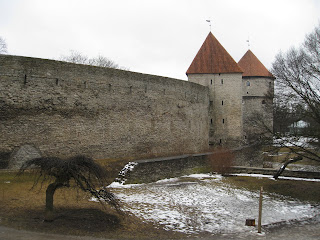
I love everything that looks like this.


Tallinn does have that Russian feel, and you do find Russian cafés with all your typical tarts and cakes. You also find these kinds of café's, which to me feel extremely "hip-Scandinavian". Everything is 10 times as expensive in these kinds of cafés. Of course.


English-inspired pub. I love the straightforward wine menu, and the clock to the left. I had at least two raspberry beers and one cherry beer here. Stuff you don't find in Norway! Here we also met some people who took us to local bars, the kind that doesn't close (and that doesn't have any signs signalling they are actually there), until five in the morning।


View over Tallinn.

Every time I go on a holiday, I always end up with feet that hurt. You aren't that very sure about the public transport system, so you end up walking a lot more than you usually do, and you usually do this for several days in a row. You can however visit Tallinn without any excessive strain on your feet, because the city is tiny! Well, I'm sure it isn't actually that small, but when it's constantly snowing or raining, you don't necessarily go that far outside of the city center.

I like Tallinn. In the old city you get that medieval feeling, very similar to the Old Town in Stockholm, just bigger and better, and outside of it, you get that same feeling as in Russia. Perfect. There's even a Russian market, Russian book stores and lots of Russian food! If there's something to say about Tallinn, it's that in this city they can brew coffee and cook absolutely delicious food! I don't think I've ever visited any place where the coffee has been as good (the worst place for coffee EVER is Paris, Oslo is half decent, St. Petersburg is expensive and not very good and Kiev is just fine, just to mention a couple of cities).

Things that you have to visit if you go to Tallinn: the Nevsky Cathedral, the Russian market, Boheem café, Town Hall medieval pub (very good food and beer!) and Kompressor (best pancakes ever).

Funny thing about my trip to Tallinn is that it has rekindled my interest for Hungarian. In a Russian bookstore (or rather, the Russian part of a big Estonian bookstore) I found a series of Ilya Frank reading method books, and not in the typical, boring languages, but in Arabic, Turkish and Hungarian! Even though they were somewhat costly, I had to get the Hungarian one, and I can't wait to start reading it! The method more or less consists in a text, where you first have a sentence in Hungarian, then in Russian within brackets, with some small comments when necessary, and then the same passage again entirely in Hungarian. It helps you read things without the use of a dictionary, and you can just read the all Hungarian text and check if you got it right by then consulting the interlaced text. Quite handy.

I also managed to read some books during my trip, and I thought I'd give them short reviews here.


Embers by Sándor Márai.

This book starts off a bit weak, but then it gains something with every page. It's like a mini mystery, where you know that something has happened, that someone is perhaps dead and that this has had an immense impact on the main character, but you have no idea what actually happened, and the story unfolds mainly through a monologue. This book should be read rather quickly I think, so that you more or less stay in real time with the dialogue/monologue that unfolds the mystery.


Джаз-банд на Карловом мосту by Дина Рубина.

I kind of liked На солнечной стороне улицы, even though it had its faults. This book mostly has faults. There is one brief passage in the beginning, dealing with Kafka and letters written to and from Kafka (i.e. not written by the author) which are interesting. Anything she has written herself is just crap. This book is supposed to be a recollection of journeys to different countries, something about the atmosphere or soul of each place. I think that was supposed to be the point. Instead, it's the arrogant bragging of a mediocre Russian author (who has published 40 books! Who is invited to hold lectures! Who understands people in any language without actually knowing the language, just through her superior ability to communicate! Who loves to bring up the martyrdom of the Jews every chance she gets and who has absolutely no idea how to use punctuation!). I hate this book so much that I actually didn't read the last 15 pages and left it on the bed in the hostel in Tallinn.


Monsieur Vénus by Rachilde.

This could have been quite good. I had never heard of Rachilde before, and I kind of suspected that was because she wasn't actually a good writer. Kind of like Marquis de Sade; she can't write, but she writes about scandalous things, so she gets famous anyway. This book (from 1884) about a woman, who is perhaps more like a man, who meets a man, who is perhaps more like a woman, does have some interesting things in it, and it wasn't boring to read, but sometimes it just embarrassingly melodramatic and weird.

Thursday, March 29, 2012

Closely related languages. Ups and downs.

People often ask me if studying Ukrainian is confusing considering I study Russian as well (but no one ever asks this question regarding Norwegian and Swedish, and I don't really know why). Actually, it is a bit confusing. Many seem to think that since Ukrainian is so similar to Russian, it should be extremely easy to learn. I'm not sure those people have ever tried learning a closely related language, but if they haven't, they should give it a try. Some parts of it are obviously easier, such as shared vocabulary and grammatical structures, but the spelling can really get to you. It's the same thing for both Russian/Ukrainian and Swedish/Norwegian: almost every word that is of common origin is spelled somewhat differently. You will always understand the word, and for Ukrainian you can almost all of the time also understand what case it is in (even though there are confusing cases, like prepositional -ому, genitive -у and probably some other things that I have forgotten), so you don't actually have to learn these forms to be able to understand them both written and in speech. But in order to use them yourself... you know what word to use, you just don't know where the damned ь і ї will go this time!

Pronunciation is also a source of confusion, since Ukrainian е is pronounced like Russian э, and Ukrainian є is pronounced like Russian е, and Ukrainian и like Russian ы, etc. All of a sudden I find myself reading "развытые" instead of "развитие" out loud... And keeping track of all those non-palatalized consonant+е combinations in Ukrainian can be really tricky!

Today, however, I think I experienced problems writing in Russian for the first time. I caught myself adding third person singular/plural -ть endings instead of -т (формы изменяються, употребляються) all over the place, and of course while using a pen you can't erase. What is having the greatest impact on my Russian writing is the Greek alphabet though. I find myself unable to write small Russian Д and Ф. I have to start Р from the bottom all the time (compulsively) since that is how I do it in Greek, and that makes me confused and makes me go "wait... how did I use to write Р?" (answer: I have no idea!!). Especially trying to copy out a text in Russian explaining Ukrainian grammar with a Greek ghost hanging over me has had catastrophic results.

I've had a frustrating day (year, life?).

On the whole, I would say that I'm quite discouraged by how slowly I am learning Ukrainian. I know I should take into consideration that I have very little time for it. I usually don't manage to prepare anything for my language tandem meetings, so we only end up chatting, something I'm not convinced is very efficient for learning. I will continue struggling though, today with the use of the site http://tyzhden.ua/History/ and http://www.lnu.edu.ua/lknp/mova/in/ser/main1.html.

This is an interesting video in Russian/Ukrainian on Ukrainians living in Norway (thanks to Vera who showed it to me!):

Sunday, March 25, 2012

Just what I needed!

I love it when you go to a flea market, find 11 books in like 10 minutes and your friend does not go "should you really buy that many books?" but instead says "should I help you carry that?", and the guy selling them agrees to give them all to you for some eight euros. Heaven.

As we left, I saw a huge room with more boxes of books through the window. Walking away was hard, but necessary.

And I forgot to look for the things I went there for.

Anyway!

And I have no idea why Blogger turns the picture around. It has never done it before. Any ideas?


Donna Tartt - The Secret History. I have read and loved it twice, but never owned it. Now I have a tattered Norwegian copy.

Karen Armstrong - A History of God: The 4,000-Year Quest of Judaism, Christianity, and Islam. Looked really interesting.

Anne B. Ragde - Berlinerpoplene & Eremittkrepsene. Very famous Norwegian books that I haven't read.

Emmanuel Carrère - D'autres vies que la mienne. I've read Carrère before, before being fluent in French. I thought I should try another one now that I will understand 100%.

Morris Bishop - The Penguin Book of the Middle Ages. This just looked interesting.

Sándor Márai - Embers. I've been wanting to read something Hungarian for a long time.

Herta Müller - The Land of Green Plums and Even Back Then, the Fox Was the Hunter. Ever since she won the Nobel Prize and I heard of her I've been interested in reading some of her books.

Kazuo Ishiguro - Never Let Me Go. A friend of mine read this book recently and really liked it, and I haven't read anything by Ishiguro at all.

Monique Truong - The Book of Salt. I get the impression I see this book everywhere and I took that as a sign.