Sunday, May 29, 2011

Just one more exam to go.

I haven't finished a book in ages. But let forget about that, it's only making me depressed. I'm in the middle of four now. Perhaps more. Gngh.

I always kind of envy people who study Japanese, because they have a ton of anime they can get addicted to and thereby get lots of free exposure. I'm never able to find anything interesting in Russian (just like I can't find any fabulous novels in Russian). Buuut, luckily, other people occasionally find things for me. Vera recommended the series И всё-таки я люблю, and finally I have something to watch. I once tried my luck with a modern version of Dr. Zhivago, but I found the horrible overacting insupportable. This series is much better, and even though I have only seen two episodes so far, I think I'm already a bit hooked. Which was exactly what I was looking for.

Try it for yourselves.

Of course, other suggestions for Russian series are very welcome.

Other than that, I can mention that I got my first "Russian" working at the tourist information the other day. Of course, I have never spoken Russian so badly before, but that's life. My job is proving very useful for my French, because I get French tourists almost every day, and I realize that my spoken French is perhaps not what it used to be. Children, never forget the importance of maintenance!

Sunday, May 8, 2011

More cat.

Norwegian has one word that is very cute: ymse. In Swedish, I would use a far less exciting word, notably diverse. This word suits this post very well, because it's just a little bit of everything.

I have almost caught up with my book reading. With almost I mean that I've been cheating a bit. In order to be able to say that I have read anything at all, I decided to throw in the tiny volume Mordre au travers by Virginie Despentes, and since I finished reading Three Sisters in Russian, I will count that as well.

So what do I have to say about Mordre au travers? This is a collection of short stories written in the 90s; most of them in classical prose, two in a semi-poetry format. First of all, I must say that Despentes is not the kind of author that is suited for collections of short stories. Her short stories are always sensational, and they are best enjoyed one by one in some obscure literary journal. When you read them in a collection like this, you get used to the format and you know that whatever the topic is, it's going to end very, very badly. And it does. This collection of short stories contains the most provocative material I have seen from Despentes so far. Sometimes, it's too provocative and it loses parts of its literary value because of it. But some of these short stories contain very good stuff. Despentes is very skilled at creating frantic inner monologues. And she can paint a picture that will stay put in your mind for quite some time. These short stories talk about sex, prostitution, poverty, murder, weird stuff and self-hatred. Sale grosse truie is among the saddest things I've ever read. A terme is definitely one of the most disturbing things I've ever read - but it may be going go a bit over the top (people with children should probably not read it). A little bit less sensational, and it would have been better. I very much like the touch of... fantastique, that she quite unexpectedly threw into two of the stories. I see myself rereading these stories sometime in the future, and that's a really good sign. As I was reading them, I did however feel that something was missing in them, that they could have been better than this. Or other, that they should have been.

And today I happened to visit a flea market.


A friend of mine didn't know who August Strindberg was during our bi-monthly Quiz at University, so for her birthday - as a joke - I gave her one of his books in Norwegian. Since I have been wanting to re-read Röda Rummet (the only novel of his that I have read), I was quite pleased to find it today in Swedish (together with three other works by him). I'm not reading Swedish classical literature in Norwegian. Anyway, I find it quite strange that Norwegians should not know who Strindberg is, when they are so obsessed with Sweden. Now, I'm not sure if regular Swedes know who Hamsun and Ibsen are, but I "always" have. As a funny side note, when the Russian author Aleksej Slapovskij visited Oslo during the Russian days at the House of Literature, he spoke of how Russians are interested in the culture of other countries. He said that they are familiar with Norwegian authors, and listed Hamsun and Strindberg ;) The audience began laughing (it happened to be an educated one, with people who know who Strindberg is and where he comes from) and then he corrected himself with "of course I meant Ibsen". Alexander Kielland is a classic Norwegian realist author, and I have already mentioned Bjørneboe a thousand times. I haven't actually read anything by Rainer Maria Rilke, but I've understood that I should, and I have Lettres à un jeune poète in French.

I got a request for more photos books, and since a cat happened to climb into this particular bookshelf, I couldn't resist taking a photo of it. A second cat came to join it.


Even though I should be preparing for exams and writing essays, I have been flirting with... Lithuanian. It's a very cute looking language, and it is a very interesting one because of its archaic character. I haven't been doing anything serious with it though, I've just done a couple of lessons over at http://ikindalikelanguages.com - a great site for easy going introductions to languages. The site happens to be owned by a Lithuanian, so the Lithuanian course is quite extensive, and very much fun!

Monday, May 2, 2011

Busy times ahead.

I promised Vera I would show some photos of my notes from my Slavic language history class. The exam is in a month, so I had better start learning all these rules. I'm not at all worried about the part where we have to read a text in old Slavic, but memorizing rules... not my favorite thing to do, unfortunately. Posting may become somewhat sparse here in the time to come since I have to write two more essays (one includes reading quite a lot), prepare for this exam and the translation exam, pass a smaller literature exam in eight days and somehow try to read some fiction. I have now missed two 1-book-a-week books :S


This is the most recent text I've been reading, on how Oleg took Kiev in 882. Doesn't it look pretty?


And happy news! I got my Bible from the Ukraine a couple days ago. Once again, I love eBay. When exams are over I'm going to have some fun with this one and the old church Slavonic textbook I read through.


I never post photos of my cats anymore. Let's change that.


Also, I kind of have a problem with Blogger. Every time I use the non-HTML version of the text editor, the text changes into some Indian script every time I press space. Anyone know why that is?

Wednesday, April 27, 2011

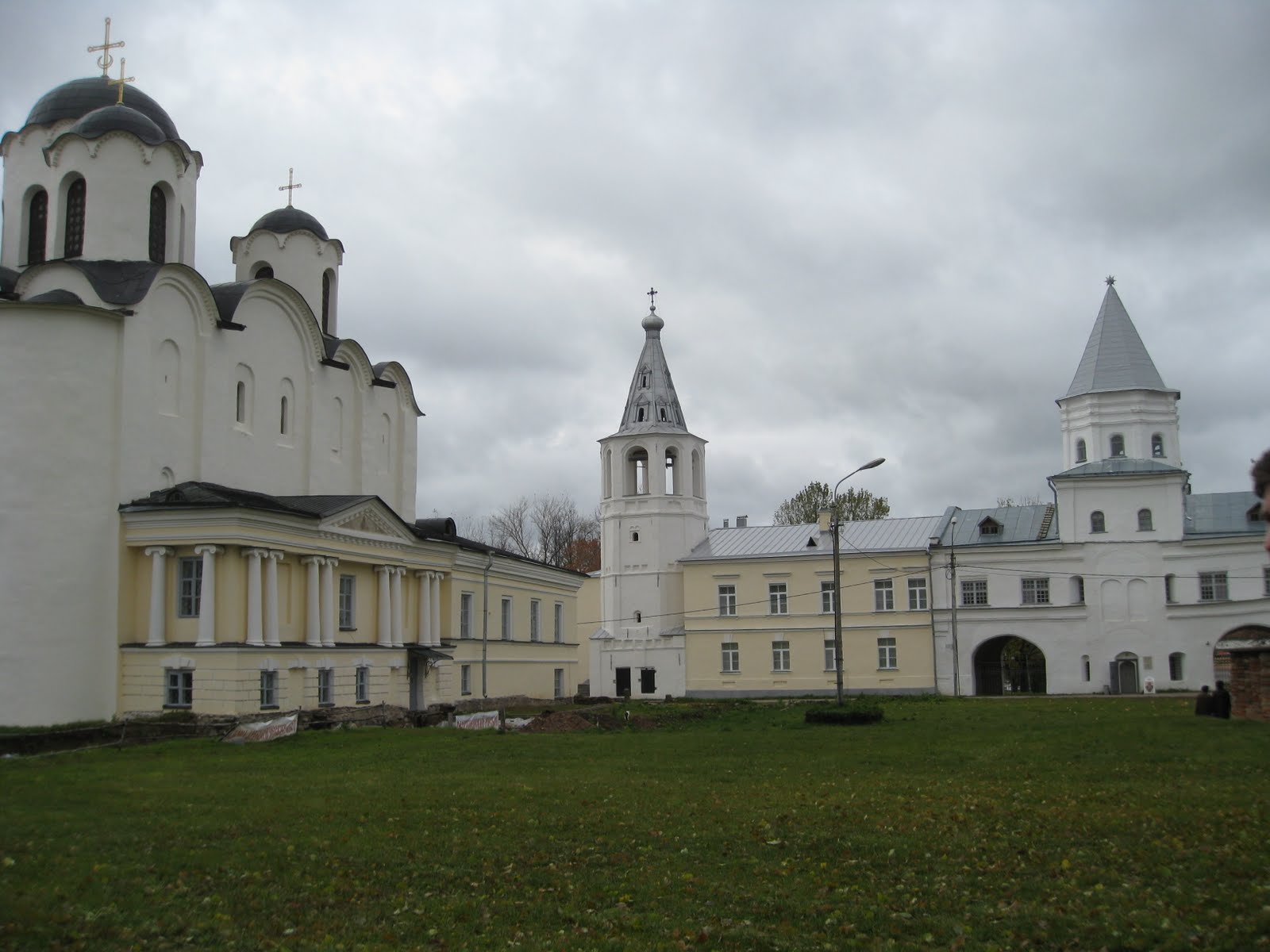
Novgorod photo post.

I started a OCS language learning log on the HTLAL forum, but since you aren't supposed to post photos over there, I will continue to post things related to that subject here as well. And since there has been some talk of Novgorod in my log, I thought I should post some photos from our one-day trip there last fall. If any of the names are wrong, please feel free to correct.

Novgorod is one of Russia's oldest cities, from back in the days when there wasn't even a Russia, but a Kievan Rus' consisting of princely states. Especially in Novgorod the Prince's power was quite limited; the veche (town assembly, prominent in Novgorod) and the boyar duma (council) had considerable power as well. A displeased veche could actually throw out a Prince; there was no autocracy, and because Rus' suffered from political instability this has been used as an excuse for autocracy later on। Rus' can seem quite civilized actually। There was less corporal and capital punishment, less torture and women's conditions were better. Compared to what? To the brilliant West of course ;)

The city was founded in the 10th century - perhaps the 9th according to Wikipedia, but I'm quite certain our Professor claimed it was the 10th. The problem can be that those who wrote about the city did so centuries later (notably Nestor in Kiev, which is quite far away), when Novgorod was already one of the biggest and most important cities. They may therefore have supposed that any important things that took place in their prehistory must have taken place in Novgorod. However, Novgorod is literally "the new city", and there is an even older city not all that far away: Staraja Laduga. So what may have been referred to as Novgorod in later writings can have been Staraja Laduga. Archaeology can only back up claims of the city's existence to the 10th century.

In 1951 a lot of old writings were found in Novgorod, written on birch bark. Someone provided me with a link to photos of these in my log. According to estimations, there may be more than 20,000 such writings in Novgorod, but it's hard to find out since the city is most likely standing on top of quite a lot of them.

Sources: Wikipedia and a book from our university, "Older Slavic texts" by Bjørnflaten (my professor) and Walter G. Moss' A History of Russia.


The Kreml of Novgorod.

Statue inside the Kreml.

Софийский собор. Built in 1045-1050. That's OLD.

(Very cuddly) dogs playing inside the Kreml. :)

Dog in dire need of attention.


Swedes being boiled.

I can't remember exactly where these different churches were, but I think these ones are outside of the Kreml.


Church of St. Paraskeva Piatnitsa on the Marketplace. 1207.

And a monastery close by.

Спасский собор Юрьева монастыря. 1119.

Sunday, April 24, 2011

More on my new infatuation.

(No, it's not the iPad.)

As I mentioned earlier, I have had an iPad2 at my disposal during the last week. Since I am already the owner of a Kindle, I have always had some trouble imagining what I would use an iPad for. Halfway through the week, I realized what they were made for: reading language related PFDs. OF COURSE! The Kindle is no good for this; it can read PDFs, but the screen is too small and you have to flip it over, and each PDF page is then cut up into three Kindle pages. Not ideal when you are dealing with documents containing tables and pictures.

But just look at this...

Incidentally, in this photo you can glimpse a new cultural magazine that is being published in Norway. Yay! The country is not dead yet!

Now I'm sad about having to return this thing :-(

The document displayed on it is a new Old Church Slavonic tutorial that I found. It's meant for people who want to read prayers and such in OCS (cause it's heresy to translate these texts :P), but it seems very thorough and I am just reading through it right now, currently at page 70 or something like that. There are lots of exercises but I'm not doing them now, because it would only get me stuck somewhere and I would most likely not finish reading the actual text. It's a good book though, and the exercises look good, so I will try to do them later.

Delightfully sinister, don't you think?

In order to make preparing for exams somewhat less painful, I have also dug up my old bloc notes from France and done some fiches de révision. These things shouldn't be underestimated - provided you actually look at them after making them. And they kind of make me feel like an actual student again!


I would also like to go ahead and recommend a book that was recommended to me some years ago, К истокам слова.


This is a great book on etymology, for a non-specialized audience. Something that amazes me with many Russian nonfiction books is how easy they are to read. The authors actually go to the trouble of writing complete sentences and of not leaving out a lot of information, supposing you will get it yourself. I don't know how many of the examples presented in this book I will actually remember, but it's fun to read and you get a general picture of how words can be formed and change over time. I have only read half this book, but I hope to finish it before my Slavic language history exam ;)

Is your background important?

This is a post where I hope to get some participation from any readers I may have. This blog is way too particular to attract any great amount of people, but I figure there must be some people who have something to say.

What I want to know, is what kind of background you have with either reading or languages (or both). If you are very interested in literature, how much contact did you have with books when you were a child, when did you start reading, etc., and what kind of languages were you surrounded by? If you are today fluent in four languages, did you grow up in a multilingual environment or are you the only one in your family who has an interest in languages? Those kinds of things. I will provide an example by answering myself.

Before I could read, I did have some weird kind of attraction towards books. I would play librarian with one of my friends and tell her what the books were about, without being able to read the title, or by just looking at the cover. I'm not sure I read all that much as a child though, I'm not sure I read more than others (I was part of a book club though and always read the books I got), but I did probably write more than other children. My mother used to talk about my older brother who would read and write for hours and hours when he was a child, and I tried to copy him because it sounded like such a sensible and intelligent thing to do. Since my mother is a teacher of English and Swedish, she had a great deal of English books at home, but I was always convinced that I would never ever learn that language (I can remember the exact position I was standing in, the form of the book I was holding, the room I was in, when I was six or so years old and thought "this is impossible"), so I would just sit and look at the words.

Then I learned English as by magic. But I didn't show any great interest in languages that early. I didn't start learning any until I realized I should be able to read books in French when I was 18, since I had studied that language in school for years. And when I started putting books and languages together it was a done deal.

One can safely say that I was surrounded by books as a child, and to a certain degree by at least one language, but how about the rest of you?

Saturday, April 23, 2011

Oh szív! Nyugodj

Most of the people who usually take up my time are not around right now, so I'm spamming the blog. I thought it was about time I posted something related to Hungarian, and I also wanted to "keep" this particular video that my Hungarian language partner showed me: Óh szív Nyugodj, a poem by József Attila, "sung" by Ágnes Vanilla.


Fegyverben réved fönn a téli ég,
kemény a menny és vándor a vidék,
halkul a hó, megáll az elmenő,
lehellete a lobbant keszkenő.

Hol is vagyok? Egy szalmaszál nagyon
helyezkedik a csontozott uton;
kis, száraz nemzet; izgágán szuszog,
zuzódik, zizzen, izzad és buzog.

De fönn a hegyen ágyat bont a köd,
mint egykor melléd: mellé leülök.
Bajos szél jaját csendben hallgatom,
csak hulló hajam repes vállamon.

Óh szív! nyugodj! Vad boróka hegyén
szerelem szólal, incseleg felém,
pirkadó madár, karcsu, koronás,
de áttetsző, mint minden látomás.

Fegyverben réved fönn a téli ég,
kemény a menny és vándor a vidék,
halkul a hó, megáll az elmenő,
lehellete a lobbant keszkenő.

Hol is vagyok? Egy szalmaszál nagyon
helyezkedik a csontozott uton;
kis, száraz nemzet; izgágán szuszog,
zuzódik, zizzen, izzad és buzog.

De fönn a hegyen ágyat bont a köd,
mint egykor melléd: mellé leülök.
Bajos szél jaját csendben hallgatom,
csak hulló hajam repes vállamon.

Óh szív! nyugodj! Vad boróka hegyén
szerelem szólal, incseleg felém,
pirkadó madár, karcsu, koronás,
de áttetsző, mint minden látomás.